Template
UX Research Repository Template for Notion
Research Repository OS
Research Repository OS is a Notion template that keeps research findings usable after the study ends. Every insight is linked to the studies, participants and sources behind it, and carries a verdict on how much evidence it rests on: strong, moderate, single study, or stale.
Built for product managers and researchers working without a research ops team, by a former CX/UX researcher in big tech.
$39 · Works on the free Notion plan
Buy on Notion MarketplaceThe problem with most research repositories
"We already know that."
Do you? A claim gets repeated in decks for two years. Nobody remembers it came from one participant, in a single test, on a screen that has since been redesigned.
Most repositories make this worse. They're built for storage: tag a finding, file it, search for it later. But finding it was never the hard part. Knowing whether it still holds up is. A finding stored without its evidence looks just as solid as one backed by five studies, so the repository repeats it with the same confidence every time someone searches.
Research Repository OS is built around that second question.
What's inside: five connected databases
Each database does one job, and they're linked, so any insight can be traced back to the studies, people and sources behind it.
Insights
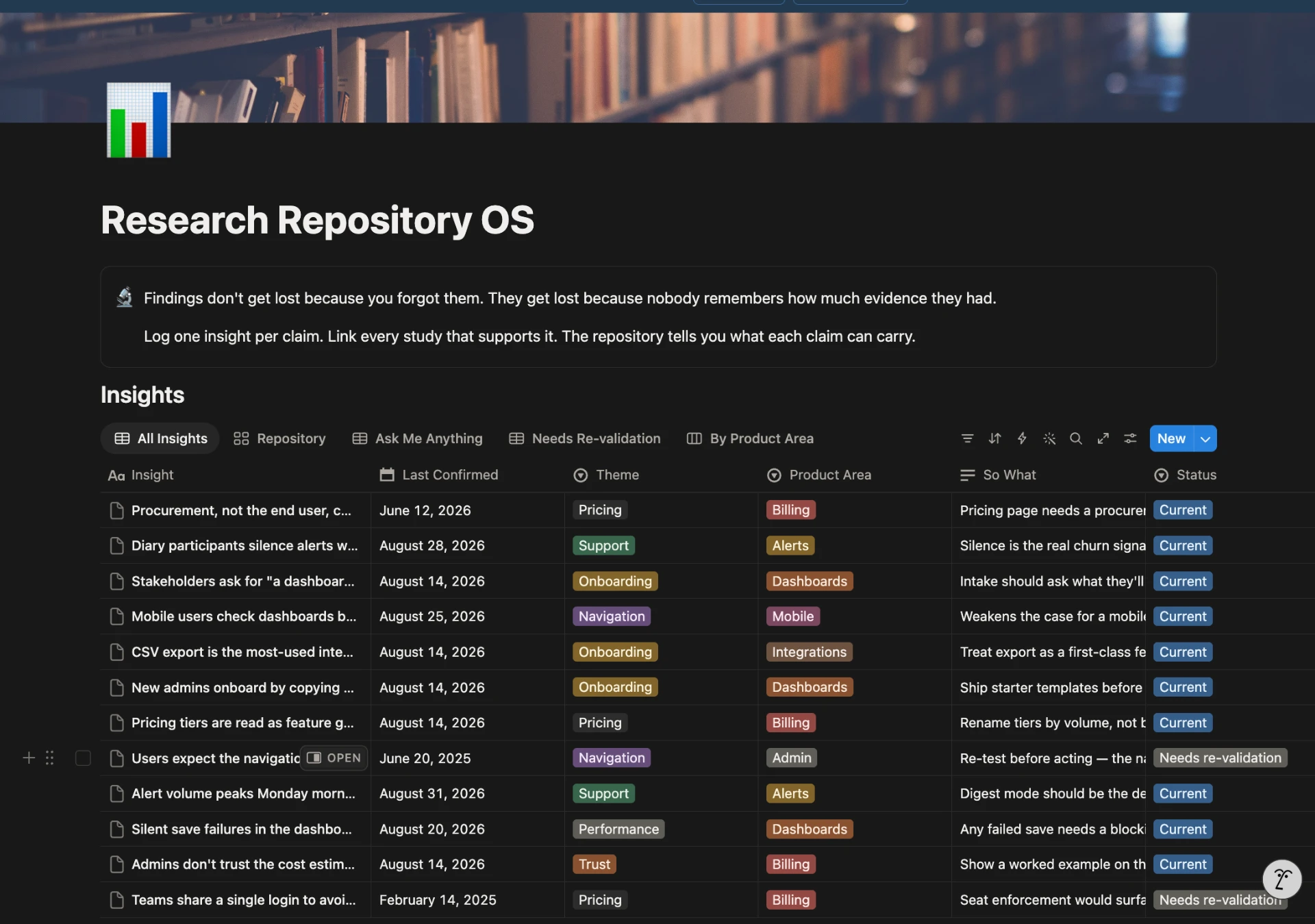
One row per claim. Link the studies that support it, and the insight shows its Evidence Strength verdict, such as "Strong — 4 studies" or "⚠️ Stale — 15 months". The Needs Re-validation view lists everything that rests on a single study or hasn't been confirmed in over a year, so your re-validation list builds itself.
Studies
Your research pipeline, from Planned through Fielding to Delivered. Each study links to the insights it produced and the participants who took part.
Participants
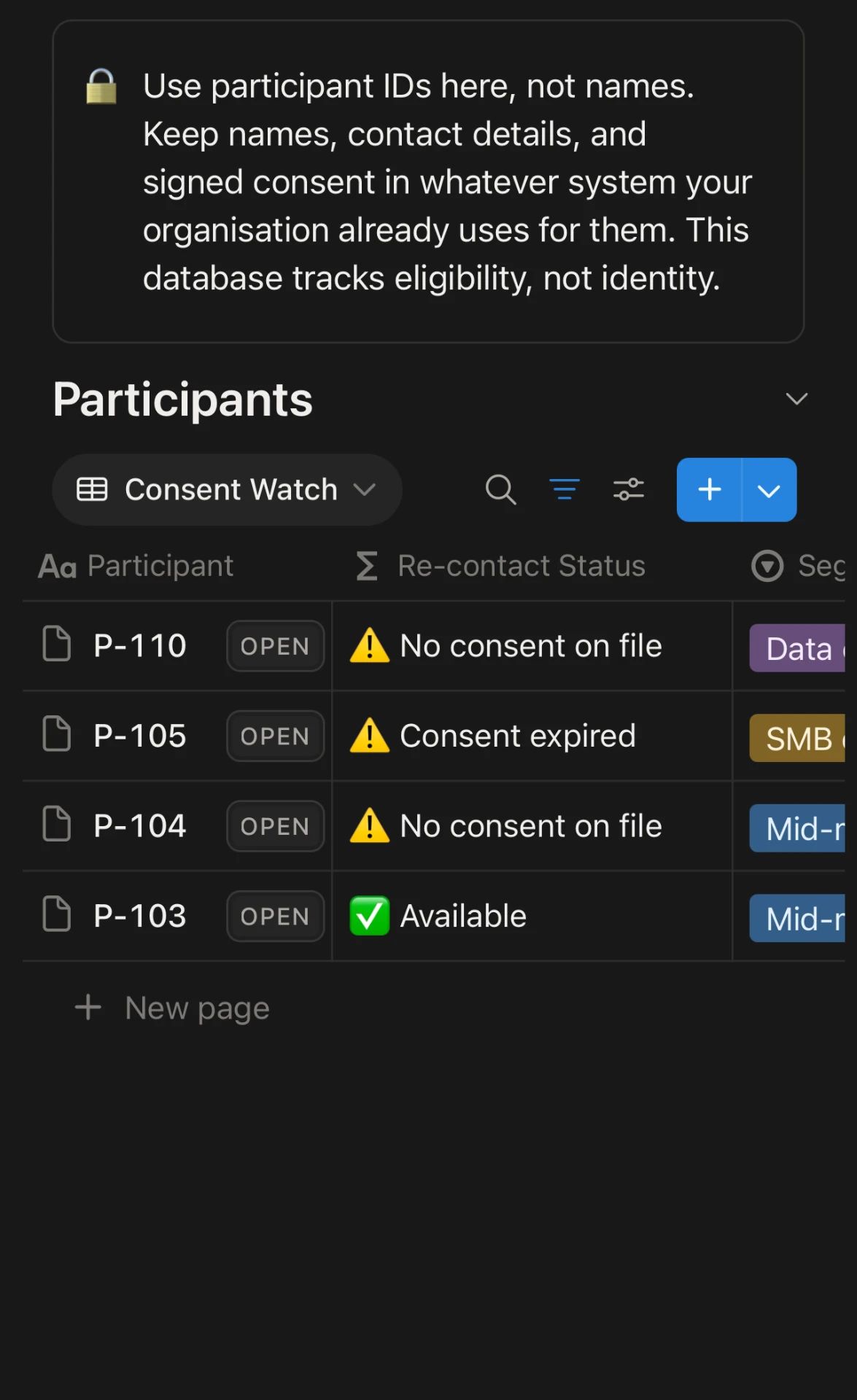
Consent and re-contact tracking. Every participant shows a status: available, recently contacted, consent expired, no consent on file, or do not contact. It tracks eligibility rather than identity, so personal details can stay in your own systems.
Requests
The intake queue for research requests. Each request names the decision it will inform, and an "Answered from repository" status records the questions you resolved without running a new study.
Sources
Articles, market reports and papers, with author, publication and date as real fields, linked to the insights and studies they support. It uses the same fields as the free Research Source Library.
Comes with a worked example, a fictional B2B analytics product, so you can see every view working before you add your own research.
How Evidence Strength works
Evidence Strength is a verdict on how much weight an insight can carry. It's calculated from two things: how many studies support the insight, and how long it has been since one of them last confirmed it.
| Verdict | Rule |
|---|---|
| Strong | 4 or more supporting studies |
| Moderate | 2 or 3 supporting studies |
| ⚠️ Single study | 1 supporting study |
| ⚠️ Stale | Not confirmed in over 12 months, however many studies back it |
| No studies linked | Nothing linked yet |
Staleness is checked first. An insight backed by four studies but not confirmed in two years is marked stale, not strong. That's deliberate: a strong-looking finding about a product that has since changed is more dangerous than a weak one, because its apparent strength is what stops people questioning it. When a new study observes the insight again, update its Last Confirmed date and the verdict refreshes.
It counts studies, not quotes or participants. Ten quotes from one study are still one study. There's a separate Confidence field for your own judgment, because sometimes one well-run study is enough.
The thresholds are a starting point, not a standard. You can change them in the formula.
For a fuller rubric that also weighs research methods, recency and contradicting evidence, use the free Evidence Strength Calculator.
Who it's for
- Product managers who run or commission their own research and need to know what a decision rests on.
- Solo researchers working without a research ops team.
- Small product teams that have outgrown a folder of old decks but don't need a research platform yet.
Who it isn't for
- Teams that need transcripts, video clips or AI tagging. Dedicated tools like Dovetail do that. This template holds the conclusions and the evidence behind them, not the raw recordings.
- Teams storing sensitive participant data, such as health information. The Participants database tracks consent and eligibility. It isn't designed to be a compliant store for personal data.
- Research organizations with a ResearchOps function and an established platform.
Questions about research repositories
How do I build a UX research repository in Notion without a research ops team?
Use linked databases instead of pages. Write each insight as a claim in its own row, link it to the studies that support it, and record when it was last confirmed. That link is what later tells you how much evidence a claim rests on. The ongoing work is small: after each study, add it, then write or update the insights it produced. Research Repository OS sets up the structure, so you can start adding studies the same day.
What should a UX research repository include?
At minimum, insights written as claims, the studies they came from, and a link between the two. Most teams also need participant consent status, so nobody re-contacts someone who opted out, and an intake list for research requests. If your insights draw on desk research as well as your own studies, track sources too.
How do I know if a research finding is strong enough to act on?
Check how many independent studies support it and how recently it was confirmed. A finding from one study, or one not re-observed in over a year, is a hypothesis to test, not a fact to build on. The free Evidence Strength Calculator scores a single finding on six factors, including research methods and contradicting evidence.
Should I use Notion or Dovetail for a research repository?
Use Dovetail if your team needs to store and analyze raw research: transcripts, video highlights and tagging across many interviews. Use Notion if your team already works there and mainly needs the conclusions and the evidence behind them in one place, without another subscription. Some teams use both: analysis in a dedicated tool, conclusions in Notion, where product decisions get made.
Can I track research participants and consent in Notion?
Yes, for consent and eligibility: who has consented, when consent expires, when you last contacted them, and who has asked not to be contacted. Keep sensitive personal information in a system designed for it, and limit access to the Participants database to the people who need it.
Does Research Repository OS work on the free Notion plan?
Yes. It works on the free plan, on web, desktop and mobile. It's a one-time purchase on the Notion Marketplace.
Get Research Repository OS
$39, one-time · Works on the free Notion plan
Buy on Notion MarketplacePayment, delivery and updates are handled by the Notion Marketplace.
Related
- Evidence Strength Calculator (free tool): score a single finding on six factors before you build a decision on it.
- Research Source Library (free template): one database for the articles, reports and papers you read, with the same fields as the Sources database here.
- All templates for product managers
Last updated: